Press Release · Seoul National University of Science and Technology
Seoul National University of Science and Technology Researchers Develop New AI-Assisted Pipeline to Identify Errors in Construction Design Documents
Distributed by NetFrame · Originally issued via PR Newswire
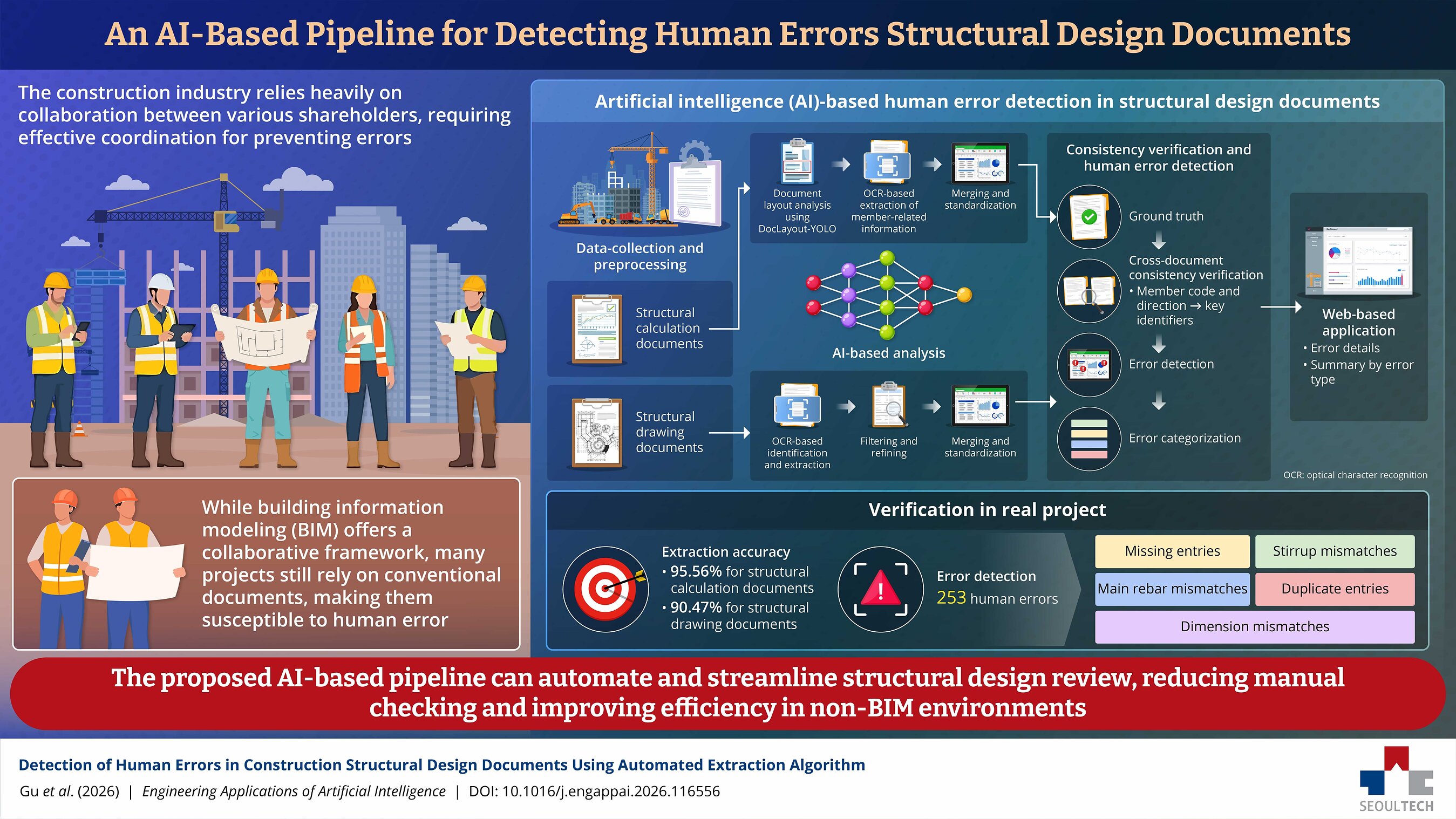
Researchers have developed an AI-assisted pipeline to detect human errors in structural design documents, improving reliability and consistency
SEOUL, South Korea, Nov. 3, 2026 — Construction projects rely on collaboration between different stakeholders. Traditional document-based collaboration can lead to inconsistencies and errors due to the varying tools used by different authors. In a new study, researchers have developed an AI-assisted pipeline that automatically extracts, organizes, and compares structural information across different documents, identifying human errors without using building information modeling. This will be particularly beneficial for small- and medium-sized construction projects that cannot implement expensive digital tools.
Collaboration is crucial in construction, but document inconsistencies can cause costly delays. While Building Information Modeling (BIM) helps, high costs and technical barriers often leave projects reliant on traditional document-based collaboration, risking miscommunications between stakeholders.
When stakeholders use different tools and formats, discrepancies often arise between structural calculation documents and drawings: human errors that can severely compromise building safety. Preventing such errors, therefore, requires meticulous management.
To alleviate this burden, a research team led by Associate Professor Jaewook Jeong from the Department of Safety Engineering at Seoul National University of Science and Technology in South Korea, has now developed a new artificial intelligence (AI)-assisted automated pipeline for detecting human errors in structural design documents. "Our AI-assisted framework automatically extracts, organizes, and compares information from structural calculation documents and drawings to identify inconsistencies that may result from human error. Importantly, the system performs these checks without relying on BIM, making it particularly relevant to construction projects that continue to use conventional design documents," explains Dr. Jeong. Their study was made available online on October 13, 2026, and published in Volume 185 of Engineering Applications of Artificial Intelligence on December 01, 2026.
The proposed automated pipeline first prunes low-quality data and standardizes information. For calculation documents, it uses layout analysis and optical character recognition (OCR) models to extract structural member data. For drawings, it uses OCR and computer vision techniques to locate, filter, and standardize table regions containing member codes.
Using member codes and directions as identifiers, the system cross-validates data, detects errors, and flags duplicates. The researchers deployed this pipeline through a user-friendly, web-based application.
In a South Korean residential project case study, extraction accuracies reached 95.56% for calculations and 90.47% for drawings. Verification identified 253 discrepancies, including 224 missing entries, 18 reinforcement mismatches, eight dimensional discrepancies, and three duplicates, proving the framework's verification potential.
"Our AI-assisted pipeline could help structural engineers, design consultants, contractors, and construction supervision teams to identify discrepancies before they lead to construction errors, improving reliability of buildings and infrastructure," notes Dr. Jeong, emphasizing its value for projects unable to implement BIM.
This innovative framework reduces manual checking burdens and could integrate into routine engineering workflows, making advanced safety technologies more accessible for small- and medium-sized projects.
Media Contact:
Seo-Hee Yoon
82-2-970-9166
[email protected]
Reference
Title of original paper: Detection of human errors in construction structural design documents using automated extraction algorithm
Journal: Engineering Applications of Artificial Intelligence
DOI: https://doi.org/10.1016/j.engappai.2026.116556
SOURCE Seoul National University of Science and Technology
About the institute Seoul National University of Science and Technology (SEOULTECH)
Website: https://en.seoultech.ac.kr/